

How Often To Clean My Nasal Rinse Bottle
| Nasal irrigation | |
|---|---|
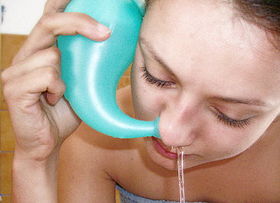 Adult female flushing her nose with a neti pot | |
| ICD-nine-CM | 22.0 |
| MeSH | D055556 |
Nasal irrigation (also called nasal lavage, nasal toilet, or nasal douche) is a personal hygiene practice in which the nasal cavity is washed to flush out mucus and debris from the nose and sinuses, in order to heighten nasal breathing. Nasal irrigation can also refer to the apply of saline nasal spray or nebulizers to moisten the mucous membranes.
Medical uses [edit]
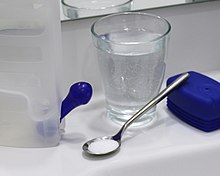
To prepare an isotonic saline solution for nasal rinsing, approx. 0.25 liter lukewarm drinking water and 2.5 ml of table table salt (nigh one-half a level teaspoon) is required.

Nasal irrigation device commonly available at pharmacies
Nasal irrigation can be an constructive therapy to salve symptoms of both chronic sinusitis likewise equally acute sinusitis caused by upper respiratory tract infections such equally the common common cold.[one] The evidence for apply in chronic sinusitis is weak.[2]
It tin too be useful for the temporary relief of the symptoms associated with allergic rhinitis.[iii]
Adverse effects [edit]
Adverse effects include nasal irritation, nosebleeds, headache, and drainage afterward the irrigation is washed. Information technology is generally well tolerated.[2]
There is a adventure of infection if the water is non sterile or the device is not cleaned after utilise. If the device is used improperly this can be harmful.[4] In fact, proper application suggests the use of boiled water or saline water. In 2018, a patient was reported to have contracted Balamuthia mandrillaris after one month of using tap water filtered through a Brita water purifier for nasal irrigation.[five]
Rare cases of fatal naegleriasis have occurred due to nasal insufflation of the amoeba Naegleria fowleri (the "encephalon-eating amoeba") from untreated tap h2o. In 2011, 2 people died from Naegleria fowleri infections tied to using Neti pots containing tap water.[6] In 2013 a man in Louisiana died from the same amoeba.[vii]
Machinery of activeness [edit]
Flushing the nasal crenel tin can soothe inflamed tissue and remove irritants similar allergens; it may help clear fungus.[2] [iii]
Typical utilise involves the pouring or pumping of saline water through one nostril and letting it drain from the other.
Solutions and devices [edit]
Solutions [edit]
The water should not exist tap water, which may contain pocket-sized amounts of bacteria that are safe to drinkable but may be unsafe in the nose. The water should be sterile or filtered for micro-organisms; if tap water is used it should be boiled and cooled.[4] Saline solution is also sometimes used.[2]
The U.Due south. Centers for Disease Control and Prevention has a fact sheet recommending i of 4 methods to make the h2o safe:[viii]
- Boil: Use h2o that has been previously boiled for ane minute and left to cool. At elevations in a higher place 6,500 feet, boil for iii minutes.
- Filter: Use a filter designed to remove some water-loving germs. The label may read "NSF 53" or "NSF 58". Filter labels that read "absolute pore size of 1 micron or smaller" are also effective.
- Buy: Utilise water with a label specifying that information technology contains distilled or sterile water.
- Disinfect: Larn how to disinfect your water to ensure it is prophylactic from Naegleria. Chlorine bleach used at the correct level and fourth dimension will work as a disinfectant against this germ.
A number of other compounds may be included in irrigation fluids such every bit the steroid budesonide in an try to treat chronic rhinosinusitis.[nine]
Devices [edit]

Neti pots are normally used and rely on gravity and head position in order to rinse the outer sinus cavities. Typically they have a spout attached near the bottom, sometimes with a handle on the reverse side.[iv]
Various clasp bottles for nasal irrigation take also been used to apply the water.[4]
Bulb syringes are normally used for infants and children.[4]
There are besides irrigation machines bachelor that utilize electric motor-driven pumps.[4]
History [edit]
The earliest record of nasal irrigation is establish in the ancient Hindu practice of Indian Ayurveda whose roots are traced to the Vedas. Information technology was customary to perform jala-neti daily, as role of soucha (personal hygiene co-ordinate to scriptures). Jala neti, which means to cleanse the olfactory organ with water, is an one-time yogic technique from Bharat. The container used to administer the saline is chosen a "neti pot". This process removes mucus and clay and clears the nose. A 2d neti technique known equally sutra neti uses a slice of string instead of water.
See too [edit]
- Neti (Hatha Yoga)
- Postal service-nasal drip
References [edit]
- ^ Rosenfeld, RM; Piccirillo, JF; Chandrasekhar, SS; Brook, I; Ashok Kumar, K; Kramper, M; Orlandi, RR; Palmer, JN; Patel, ZM; Peters, A; Walsh, SA; Corrigan, Doc (April 2015). "Clinical practice guideline (update): developed sinusitis executive summary". Otolaryngology–Head and Neck Surgery. 152 (4): 598–609. doi:10.1177/0194599815574247. PMID 25833927.
- ^ a b c d Chong, LY; Head, K; Hopkins, C; Philpott, C; Glew, Due south; Scadding, G; Burton, MJ; Schilder, AG (26 April 2016). "Saline irrigation for chronic rhinosinusitis" (PDF). The Cochrane Database of Systematic Reviews. 4: CD011995. doi:10.1002/14651858.CD011995.pub2. PMID 27115216.

- ^ a b Hermelingmeier, Kristina East.; Weber, Rainer K.; Hellmich, Martin; Heubach, Christine P.; Mösges, Ralph (1 September 2012). "Nasal irrigation every bit an adjunctive treatment in allergic rhinitis: a systematic review and meta-assay". American Journal of Rhinology & Allergy. 26 (5): e119–125. doi:x.2500/ajra.2012.26.3787. ISSN 1945-8932. PMC3904042. PMID 23168142.
- ^ a b c d e f "Is Rinsing Your Sinuses Safety?". FDA. 24 January 2017. Archived from the original on 4 January 2019.
- ^ "Fatal Balamuthia mandrillaris encephalon infection associated with improper nasal lavage". IJID Online. International Periodical of Infectious Diseases. Dec 2018.
- ^ Moisse, Katie (xvi December 2011). "Louisiana Problems Neti Pot Alarm Afterwards Two Fatal Infections". ABC News. Archived from the original on 22 January 2019. Retrieved 17 May 2020.
- ^ "Brain infection from h2o amoeba kills 3; victim used 'neti pot'". King-TV. 4 January 2013. Retrieved 21 January 2021.
- ^ "Safe Ritual Nasal Rinsing" (PDF). CDC.gov. Centers for Illness Control and Prevention. Archived from the original (PDF) on xviii June 2019. Retrieved 17 May 2020.
- ^ Thaler, Erica; Kennedy, David Westward. (2009). Rhinosinusitis: A Guide for Diagnosis and Direction. Springer Science & Business Media. p. 82. ISBN9780387730622.
External links [edit]
- University of Wisconsin instructions, written report and video
- Saline nasal irrigation: Its role as an offshoot treatment

Source: https://en.wikipedia.org/wiki/Nasal_irrigation
Posted by: medinapealis.blogspot.com
0 Response to "How Often To Clean My Nasal Rinse Bottle"
Post a Comment